


When a dimensioning system claims to be accurate, that claim needs a definition. Accurate to within what tolerance? Under what conditions? For what package types? These are not pedantic questions. Carrier billing is based on declared dimensions. Freight class is calculated from density. Quality checks compare measured values against expected ones. All of those use cases depend on the measurement being consistently correct, not just close enough most of the time.
What accuracy means technically
Dimensioning accuracy is typically expressed as a tolerance range, for example, plus or minus 2mm or plus or minus 0.2 inches. That tolerance represents the maximum expected deviation between the system’s measurement and the true dimension of the object. Accuracy is also specified under defined operating conditions, which may include factors such as package presentation, object shape, measurement environment, conveyor speed for in-motion systems, and whether the item falls within the system’s approved measurement range. Real-world performance may differ if those conditions are not met, which is why it is useful to evaluate accuracy claims in the context of the actual operating environment.
Accuracy vs. repeatability: why both matter
Dimensioning accuracy is typically expressed as a tolerance range, which varies by system, application, and measurement conditions. That tolerance represents the expected deviation between the system’s measurement and the true dimension of the object under the conditions defined in the product specifications.
Repeatability describes how consistently the system produces the same result when measuring the same object multiple times under the same conditions. A system can be repeatable without being accurate: it might consistently measure a 12-inch box as 12.4 inches. For billing and compliance purposes, both matter. Accuracy ensures the declared dimension is close to reality. Repeatability ensures the same item produces a consistent record across shifts, stations, and time.
What NTEP certification means for dimensioning systems
NTEP stands for National Type Evaluation Program. NTEP stands for National Type Evaluation Program. It is administered by the National Conference on Weights and Measures and provides third-party evaluation for certain weighing and measuring devices used in legal-for-trade applications. For shipping and billing workflows where certified measurements are required, buyers should verify whether the specific dimensioning system, scale, or configuration meets the certification requirements for their use case.
How accuracy affects carrier billing
Carriers increasingly verify dimensional data using their own measurement systems. When declared dimensions do not match carrier-measured dimensions, the invoice changes. Carriers increasingly verify dimensional data using their own measurement systems, and parcel carriers continue to tighten dimensional billing and reporting expectations. For example, FreightWaves has reported on USPS proposals related to broader dimensional reporting requirements and surcharges when declared measurements differ from carrier-captured data. The broader takeaway is that declared dimensions need to be accurate, consistent, and defensible.
When the dimensioning system produces accurate, consistent measurements, the gap between declared and carrier-measured values narrows. For an overview of the systems Cubiscan offers, the dimensioning system page provides a starting point.
Static vs. in-motion accuracy considerations
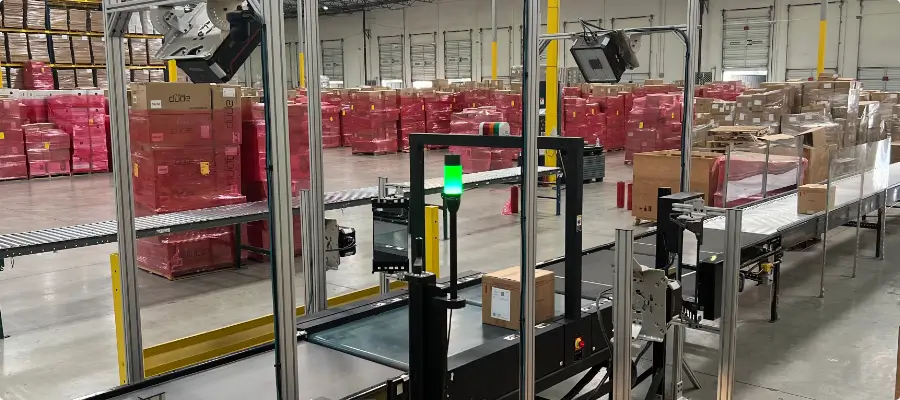
Static dimensioners measure packages at rest, which is favorable for accuracy because there is no motion-induced measurement variance. In-motion dimensioners measure packages as they travel on a conveyor. Accuracy in motion depends on conveyor speed stability, package spacing, singulation quality, and the sensor technology used. Modern in-motion systems achieve high accuracy at production speeds, but operating conditions need to be within the system’s specifications.
For static parcel applications handling mixed packaging, Cubiscan offers systems designed for parcels, flats, polybags, and other common fulfillment profiles. For master data programs, workstation dimensioners support accurate and repeatable measurement at receiving, onboarding, and audit stations. For in-motion applications, conveyorized systems support high-throughput workflows where packages need to be measured without stopping the line. The best fit depends on package type, volume, throughput requirements, and integration needs.
What to evaluate when comparing dimensioning systems
When assessing dimensioning systems for accuracy and reliability: What is the stated measurement tolerance, and under what conditions was it measured? Does the system carry NTEP certification? What is the stated throughput range, and does accuracy hold at the top of that range? How does the system handle irregular shapes and polybags? What is the calibration interval and the support model for maintaining accuracy over time? Accurate measurement is only valuable when it stays accurate. Calibration support and serviceability are part of the full accuracy picture.
Build on a foundation of verified measurement
Billing accuracy, quality programs, freight classification, and dispute resolution all depend on the dimensioning system doing what it says it does, consistently and over time. To learn more about Cubiscan’s dimensioning systems and their accuracy specifications, start with the dimensioning system overview. For product-specific accuracy data, the Cubiscan 75 Pro and Cubiscan 325 pages include system specifications. To discuss accuracy requirements for a specific application, contact Cubiscan.
Frequently asked questions
| What is a typical accuracy tolerance for a dimensioning system? Accuracy tolerances vary by system and application. Accuracy tolerances vary by system, package type, certification requirements, and operating environment. Static dimensioners and in-motion systems may have different specifications, so buyers should review the published accuracy data for the specific model and workflow they are evaluating. |
| What is NTEP certification and why does it matter? NTEP certification means a weighing or measuring device has been independently tested and verified to meet defined accuracy standards by the National Conference on Weights and Measures. It is relevant for commercial applications where measurements drive billing or classification decisions. |
| How does measurement accuracy affect LTL freight class? LTL freight class under density-based classification depends on weight divided by volume. If dimensional measurements are off, the volume calculation is off, the density is off, and the class may be wrong. More accurate dimensions produce more consistent class outcomes. |
References
• FreightWaves. USPS Proposal Requiring Small Parcel Dimensions Raises Compliance Fears. https://www.freightwaves.com/news/usps-proposal-requiring-small-parcel-dimensions-raises-compliance-fears


