


Accurate package dimensions are an emissions lever hiding in plain sight. Freight transportation accounts for about 8% of global greenhouse gas emissions, and that can be as high as 11% when warehouses and ports are included. Translation: If a parcel network is wasting space, it is also wasting carbon.
Here’s the second uncomfortable truth: Speed costs. Research highlighted by MIT’s Center for Transportation and Logistics shows fast shipping can increase emissions by 10%–12% for the same demand.
And then there’s the third truth: Lots of packages are basically shipping air with a label. Paccurate reports that in some categories, the average shipment contains up to 64% empty space. That is not “value-added.” That is a cardboard balloon.
Carriers cannot control every box a shipper chooses, but carriers can control how dimensional data is captured, standardized, and used. That is where dimensioning pays off in both cost and emissions.
The “shipping air” problem carriers end up owning
When dimensions are wrong or missing, networks make conservative choices. That usually means:
- More trailers and containers than necessary because cube planning is based on fuzzy inputs.
- More touches because oddball cartons trigger exceptions.
- More miles because route planning and sort plans are built on imperfect information.
In a parcel network, inches matter because inches determine cube. Cube determines how many packages fit in a trailer, which determines how many trailers move, which determines fuel burn. Nobody is putting “3 extra trailers per day” on a sustainability slide on purpose. It just happens when the data is messy.

Why dimension accuracy reduces emissions
Accurate dimensions help cut emissions in three practical ways.
1) Better cube utilization means fewer trips
If a trailer or container is built on real dimensions instead of rounded guesses, you can move the same volume with fewer assets. That is fewer linehaul moves, fewer dray trips, and fewer “we had to send another one” moments.
2) Fewer exceptions means fewer touches
Bad dimensional data creates mis-sorts, manual audits, re-labeling, and re-handling. Every extra touch takes time and energy, and it increases the chance a package gets reworked into a larger box (hello, extra air).
3) Fewer reroutes means fewer miles
Dimension accuracy supports more reliable planning upstream, so fewer packages bounce between facilities because the network had to improvise.
Better inputs create better decisions. Also, fewer fire drills.
Where bad dimensions create “hidden miles” in small-parcel networks
Dimension problems show up in predictable places. If you want a fast diagnostic, start here.
Induction and manifest accuracy
If dimensions are missing at induction, they get estimated later. Estimates tend to be wrong in the same direction; they are “safe,” which often means bigger. Bigger dimensions push different sort plans, different containerization, and different load builds.
Sortation exceptions and manual lanes
Odd shapes, soft mailers, reflective packaging, and inconsistent scanning all increase exceptions. Cubiscan systems are built to measure more than cartons, including polybags, bubble mailers, and other common parcel packaging. Less time in exception lanes means fewer touches and a smoother flow.
Linehaul trailer build
Trailer utilization is where emissions reduction becomes visible. If the load plan is based on dimension data you can trust, you get tighter builds without playing Tetris at 2 a.m.
Last mile and service speed pressure
When customers pick faster service, the network loses flexibility and emissions rise. MIT and AP reporting point out that faster shipping disrupts optimized routing, sometimes leading to under-filled trucks and more trips. Accurate dimension data helps regain some of that lost efficiency by improving consolidation and reducing preventable exceptions.
The DIM reality check: Rounding raised the stakes
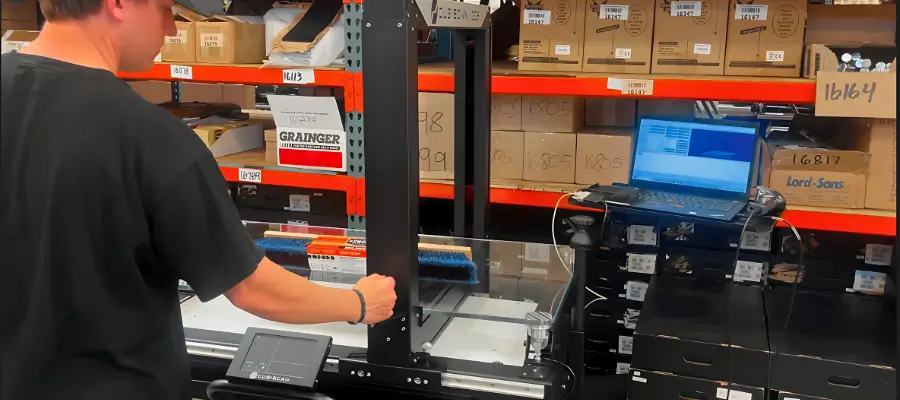
Since August 18, 2025, FedEx has stated it will round every fraction of an inch or centimeter up to the next-higher inch or centimeter. UPS also moved to rounding fractional measurements for package dimensions up to the next whole inch, matching FedEx.
What that means for carriers: Sloppy measurement is now expensive measurement. If you are capturing dimensions, capture them precisely and consistently, and store the record. You do not want to arbitrate a DIM disagreement with vibes.
What carriers should standardize in every scan record
A dimension scan is only useful if it is usable later. Standardize the record so billing, audit, and ops teams are working from the same facts.
At minimum, capture:
- Length, width, height (and the increment used)
- Weight (if available at capture point)
- Shipment identifier (barcode, tracking ID, or license plate)
- Timestamp and facility ID
- Image proof when possible
Then put the data somewhere that can actually be used. Cubiscan’s Qbit software suite is built to collect, store, export, and integrate dimensional data so it can feed downstream systems instead of living in a silo.
What carriers can do this quarter: Fast, measurable moves
Carriers are busy. Sustainability goals are real. Nobody wants another multi-year transformation slide deck. Here are practical steps that fit real operations.
1) Find the biggest “air offenders”
Use your dimensional data to identify the top SKUs, lanes, or shipper profiles that consistently ship high empty space. Paccurate’s “box of air” finding is a reminder that empty space can be massive. Your network likely has its own version of that story, and it has a tracking number.
2) Put dimension capture where it prevents rework
Dimension at the point where decisions are made, not where problems are discovered. For many networks, that means induction, audit lanes, or high-volume shipper intake points.
If you need a static workflow that handles varied parcel types, start with options like the Cubiscan 75 Pro. If you need fully automated shipping workflows with integrated weigh-and-dimension steps, look at systems like the Cubiscan 275 Pro SLAM.
3) Treat dimensional data as network infrastructure
Dimensioning is not a gadget; it is data infrastructure. Make sure you have a clear path from capture to systems that need it, and a reporting view that makes it easy to spot trends and fix root causes.
To explore the broader set of options, start at Shop Dimensioning Systems.
Make your dimensional data do real work
If your network is serious about cutting emissions, start by cutting waste. Accurate dimensions reduce wasted cube, wasted touches, and wasted miles. That is the kind of sustainability plan that also makes the dock happier, which is a rare and beautiful thing.
Want to check where dimension capture will have the biggest impact in your parcel workflow? Start with Request a Quote or reach out through Contact Cubiscan.


