


Parcel shipping is getting less forgiving. Surcharges keep expanding, and carriers are tightening how they correct billing when declared data is incomplete or off. And the compliance pressure is rising too, including proposals that would require dimensional data for more parcels, with penalties when measurements don’t match what carrier equipment captures.
That’s why dimension capture has become a core part of modern shipping operations. The big decision most warehouses face is simple: Should dimensioning happen in-motion on a conveyor line, or at a static workstation?
Both approaches can be the right choice. The difference comes down to how parcels move through the building, how much volume is flowing, and where the warehouse wants to control accuracy and exceptions.
This guide breaks down what each system does, how they differ in real operations, and how to choose the best fit.
What a parcel dimensioner does
A parcel dimensioner captures:
- Length, width, and height
- Often weight (via a scale or integrated weighing)
- Ties dimensions and weights to the unique identifier/barcode
That record reduces manual entry, improves billing accuracy, and supports shipping audits. Cubiscan builds parcel dimensioning options for both workstation workflows and automated lines. parcel dimensioners for shipping and the broader dimensioning system library show the full range.
The simplest definition: static vs in-motion
Static parcel dimensioners
A static dimensioner measures a parcel that is placed on a fixed measurement area, usually on a workstation. An associate presents the package, the system captures dimensions, and the record is saved to the cloud and posted to your WMS or endpoint.
Common static use cases include:
- Pack stations
- Shipping desks
- Audit tables
- Lower volume environments with varied packaging types
Examples of Cubiscan static parcel options include the Cubiscan 75 Pro and the Cubiscan 100 package dimensioner.
In-motion parcel dimensioners
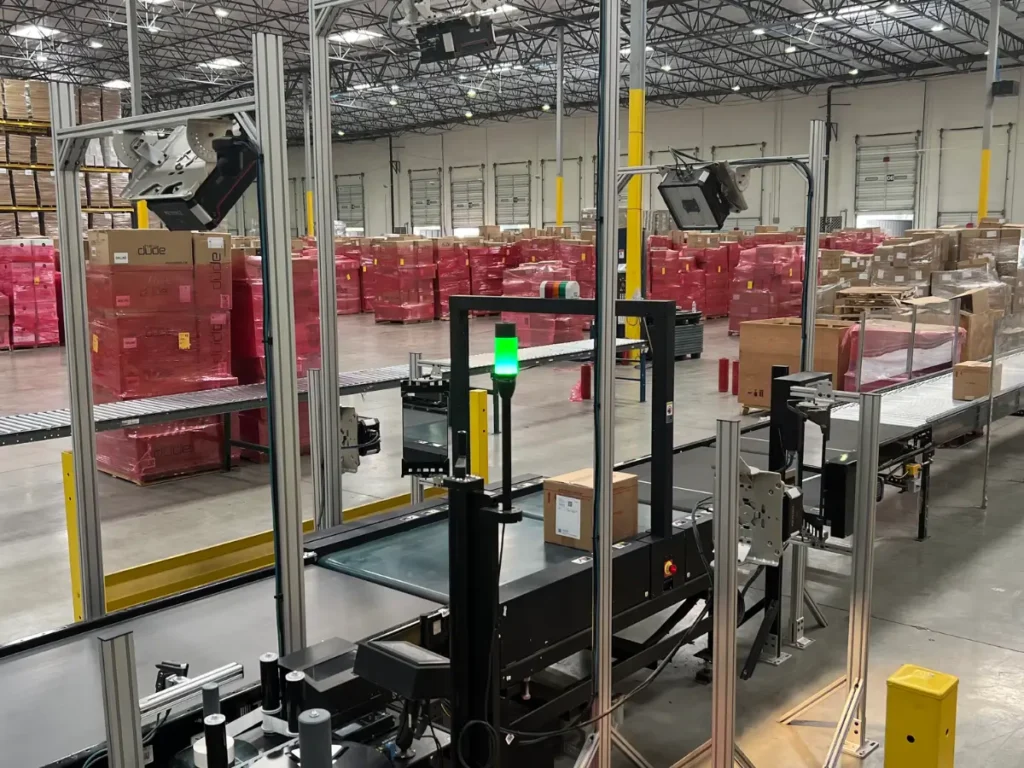
An in-motion dimensioner measures parcels as they move on a conveyor, typically as part of an automated outbound shipping line. The system captures dimensions (and often weight) in real time at production speed, tied to scanned identifiers.
Common in-motion use cases include:
- High-volume shipping lines
- SLAM line workflows (scan, label, apply, manifest)
- Carrier compliance and audit lanes
- Sortation and exception routing environments
Cubiscan’s in-motion category includes systems like the Cubiscan 200-SQ and the Cubiscan 210-L.
The key differences that matter in real operations
1) Throughput and labor impact
Static dimensioning depends on an associate handling each parcel at a station. That can work well when:
- Volume is manageable
- Pack stations already have a natural pause point
- The operation ships many packaging types, including polybags and flats
Cubiscan notes the 75 Pro can measure parcels plus mailers, polybags, and flat items, which is a common need at shipping workstations.
In-motion dimensioning is designed for volume. Parcels stay on the line and the system captures dimensions without the same stop-and-handle step. For high-throughput environments, this can reduce touches and keep flow consistent.
If the warehouse is dealing with peak-driven growth, carriers have reported volume increases during peak seasons alongside stronger service performance, which reinforces how important stable, fast processes are when volume spikes.
2) Process control and consistency
Static systems can be very accurate, but results can vary if workflows vary. Consistency improves when the station is set up with clear standard work and the team follows it every time.
In-motion systems drive consistency because the conveyor presentation is standardized. When singulation, spacing, and ID capture are controlled, the measurement process becomes repeatable.
3) Packaging variety and “real-world parcels”
Some operations ship mostly cartons. Others ship a mix:
- Boxes
- Bubble mailers
- Polymailers
- Polybags
- Tubes
- Flat items
Static systems often shine in mixed packaging environments because an associate can present unusual items directly. Cubiscan highlights this range on the 75 Pro page.
In-motion systems can support varied cartons well, but the more irregular the package shape, the more important conveyor presentation and system selection become.
4) Space and layout requirements
Static dimensioners fit well in pack areas and shipping desks. They typically require a workstation footprint and clear operator flow.
In-motion dimensioners require conveyor integration, spacing control, and upstream and downstream coordination. That investment is usually justified when the line is already automated, or when shipping is becoming the bottleneck.
Cubiscan’s automated outbound shipping solutions are often described as SLAM lines that cover the “last 100 feet” of shipping.
5) Exception handling and audit readiness
When carriers correct dimension records, costs and time follow. FreightWaves has reported that parcel delivery rates are being driven higher by surcharges and tighter rating logic for package dimensions.
That makes exception handling a real operational requirement:
- What happens if a label won’t scan?
- What happens if a parcel measures outside expected ranges?
- What happens if a record is missing weight or dims?
Static stations usually resolve exceptions by manual intervention at the workstation.
In-motion lines can route exceptions automatically into a rework lane, which is one of the reasons automated outbound shipping is so effective when volume is high.
When a static parcel dimensioner is the best choice
A static system is a strong fit when:
- Volume is moderate, and manual handling is not a bottleneck
- The packaging mix is wide, including polybags, flats, and odd shapes
- The main goal is compliance and audit accuracy without rebuilding conveyor lines
- The operation wants fast deployment at specific stations
Two solid examples:
- The Cubiscan 75 Pro for mixed parcel types
- The Cubiscan 100 package dimensioner for shipping workflows and receiving workflows that also support master data updates
Static systems are also a great starting point for teams building a culture of dimension compliance before automating the full line.
When an in-motion parcel dimensioner is the best choice
In-motion is the best fit when:
- Shipping is high-volume and the line needs to run continuously
- Manual dimensioning is slowing down outbound flow
- Carrier adjustments and surcharges are painful, and the warehouse wants tighter control of declared data
- The operation is building an automated outbound shipping line, including label apply and sortation
Systems like the Cubiscan 200-SQ are designed for automated workflows where an identifier is scanned and the parcel is dimensioned and weighed.
For end-of-line automation projects, Cubiscan’s automated warehouse shipping solution page describes SLAM line automation and the operational value of integrating these stages.
A practical way to choose: 6 decision questions
- How many parcels per hour need dimension records?
If the answer is “as fast as the conveyor runs,” in-motion is usually the right direction. - Where does the parcel naturally pause?
If parcels already stop at pack stations, static dimensioning fits cleanly. - How broad is the packaging mix?
If polybags, flats, and odd shapes are common, a static station may reduce friction. - How often does the operation deal with invoice corrections and penalties?
FreightWaves has reported USPS penalties for measurement mismatches, and a proposal to require dimensions for more parcels increases the value of consistent capture. - What is the exception strategy?
Static equals human resolution at a station. In-motion often equals automated divert and rework lanes. - Is the warehouse building automation now, or improving accuracy first?
Both paths are valid. Many teams start with static stations, then expand to in-motion as volume grows.
Make the next move based on your outbound reality
Parcel costs and compliance are trending toward stricter rules, more surcharges, and less tolerance for missing or inaccurate data. The difference between static and in-motion dimensioning comes down to one thing: where the warehouse wants to capture accurate data with the least disruption to flow.
If your operation needs flexible measurement at pack stations, a static workflow is often the fastest win. If shipping volume is driving automation decisions, in-motion dimensioning is usually the most scalable path.
To match the right option to your workflow, start with parcel dimensioners for shipping or explore the full dimensioning system lineup. For pricing and deployment guidance, use the contact page.
Frequently asked questions
What is the biggest difference between in-motion and static parcel dimensioners?
Static parcel dimensioners measure items placed at a workstation by an associate. In-motion parcel dimensioners measure items as they travel on a conveyor, usually as part of a higher-volume outbound shipping, weighing, labeling, or sortation workflow.
Which option is better for high-volume fulfillment?
In-motion dimensioning is typically the better fit when packages need to move continuously through an automated outbound process with minimal handling. This is especially useful in SLAM line environments where scanning, labeling, weighing, dimensioning, and sortation are part of the same workflow.
Which option is better for polybags and mailers?
Static dimensioning is often better for polybags, mailers, flats, and other flexible packaging because an associate can position the item consistently before measurement. The Cubiscan 75 Pro, for example, is designed to measure parcels, flats, and polybags, making it a strong fit for mixed parcel environments where packaging types vary throughout the day.
Do carriers really charge more when dimensions are wrong or missing?
Yes. Parcel carriers increasingly rely on dimensional weight, surcharges, and billing adjustments when package dimensions are missing, inaccurate, or understated. Better dimensioning data helps shippers declare package information more consistently and reduce avoidable corrections after the shipment is processed.
Can a warehouse start with static and move to in-motion later?
Yes. Many warehouses start with static dimensioning to improve data accuracy, reduce manual measurement, and standardize package data capture. As volume grows, they may expand into in-motion dimensioning when continuous flow, higher throughput, and outbound automation become bigger priorities.


