


Most dimensioning systems on the market were designed for a rigid carton world. They use laser curtains, structured light, or overhead sensors to detect package edges, measure the space between them, and calculate dimensions from the result. The approach works well for boxes. It breaks down for polybags, mailers, flats, and soft-sided items that don’t have consistent edges, that deform under measurement conditions, or that change shape based on how they’re placed on the measurement surface.
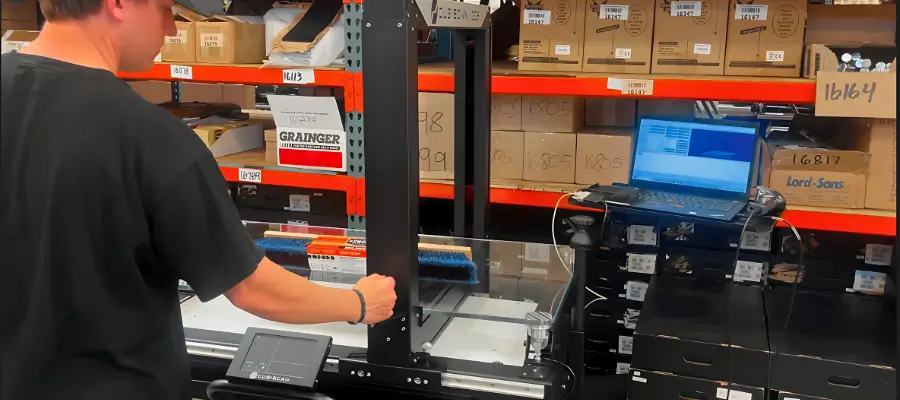
The Cubiscan 75 Pro was built to solve that problem. It uses machine learning to recognize and measure items that conventional dimensioning systems misread or can’t measure at all.
Why conventional dimensioners struggle with polybags
A laser-based dimensioner works by projecting light across a measurement field and calculating dimensions from where the light hits and reflects. On a rigid carton, that produces clean, consistent edge detection. On a polybag, the surface is uneven, the edges are undefined, and the bag deforms when placed on the measurement platform. The sensor may detect multiple edges, no edges, or an edge profile that shifts depending on how the bag settled.
The result is a measurement that’s either wrong or fails entirely. For operations that route measurement failures to a manual exception process, that means a separate handling step for every polybag in the outbound flow.
What machine learning adds to the measurement process
Machine learning-based dimensioning trains on a large and varied dataset of package types. The system learns to recognize shapes that don’t fit the geometric rules that sensor-based systems rely on. It can identify the effective dimensional envelope of a polybag even when the surface is irregular, by recognizing the shape type and applying measurement logic specific to that category of packaging.
This is different from a rule-based workaround. A rule-based system might apply a fixed inflation factor to polybag measurements or route them to a separate handling mode. A machine learning system measures them directly, producing a result that reflects the actual dimensional envelope rather than an approximation.
What the Cubiscan 75 Pro measures
The Cubiscan 75 Pro is a workstation dimensioner that handles the full range of outbound packaging: rigid cartons, flats, polybags, mailers, and irregular items. It captures length, width, height, and weight in a single trigger and feeds the result to the connected WMS or manifest system.
For operations with a mixed outbound mix, that means a single measurement station handles everything without routing specific package types to a separate process. The workflow is the same for a rigid carton as it is for a polybag.
The billing accuracy case for ML dimensioning
Polybags that go unmeasured or estimated rather than measured directly represent a persistent billing accuracy problem. If the estimate is too large, the operation overcharges itself on dimensional weight. If the estimate is too small, the carrier adjusts post-shipment. Actual measurement eliminates both forms of error by producing a declared dimension that reflects the actual package at ship time.
For operations where polybags represent a significant share of outbound volume, the billing adjustment recovery from accurate measurement can substantially affect the ROI calculation for the system. The dimensioning system overview provides context for the full product range and how the 75 Pro fits within it.
Applications beyond outbound billing
ML dimensioning has applications beyond outbound billing. For apparel and soft goods in an e-commerce or retail DC environment, accurate item master dimensions for polybag-packaged products improve cartonization and slotting accuracy for the same reasons they do for rigid items. Cubiscan cubing software stores and routes those records to the systems that need them.
Evaluate the Cubiscan 75 Pro for your operation
If polybags, mailers, or soft goods are part of your outbound mix and are currently being measured by estimate or exception, the 75 Pro addresses that gap directly. To learn more and discuss whether it fits your workflow, contact Cubiscan.
Frequently asked questions
| What makes machine learning-based dimensioning different from conventional sensor-based measurement? Conventional sensor-based systems detect package edges using laser or structured light and calculate dimensions from those detected edges. Machine learning-based systems train on a large dataset of package types and shapes, allowing them to recognize and measure items that don’t have the consistent geometry that sensor-based detection requires. This enables accurate measurement of polybags, flats, and irregular items. |
| Does the Cubiscan 75 Pro handle rigid cartons as well as polybags? Yes. The Cubiscan 75 Pro is designed as a workstation dimensioner for operations with a mixed outbound packaging. It handles rigid cartons, flats, polybags, mailers, and irregular items without requiring a separate measurement mode or exception process for different package types. |
| How does measuring polybags accurately reduce carrier billing adjustments? When polybags are measured by estimate, the declared dimensions may be too large or too small relative to the actual package. When they’re too small, the carrier remeasures and adjusts the invoice after the shipment is delivered. Accurate measurement produces a declared dimension that reflects the actual package at ship time, reducing the gap that triggers post-shipment adjustments. |
| Is the Cubiscan 75 Pro suitable for high-volume operations? The Cubiscan 75 Pro is a workstation dimensioner designed for station-based measurement, not in-motion conveyor measurement. For high-volume operations requiring conveyor-speed dimensioning, an in-motion system such as the Cubiscan 200-SQ is the appropriate configuration. For mixed packaging environments where throughput requires a workstation approach with full packaging type coverage, the 75 Pro addresses both needs. |


