


LTL freight billing is more complex than parcel billing, and the consequences of inaccurate dimensional data are more variable. Freight class, density-based pricing, and accessorial charges all depend on measurements that are often captured manually at the dock, under time pressure, with the inconsistency that manual measurement produces. For carriers and high-volume LTL shippers, the cost of that inconsistency shows up as revenue leakage, disputed invoices, and class corrections that arrive after the freight has moved.
How LTL billing connects to pallet dimensions
LTL freight is classified based on commodity type, density, and handling characteristics. Density is calculated from weight divided by cubic volume, which means accurate pallet dimensions are a direct input into the rate. When the NMFC moved more freight to density-based pricing, the connection between measurement accuracy and billing accuracy became more direct. An inaccurate pallet dimension produces an inaccurate density calculation, which produces an inaccurate class, which means the quoted rate doesn’t match the invoiced rate.
For carriers, this is a revenue leakage problem. Freight that should bill at a higher class because of its actual density gets undercharged if the shipper’s declared dimensions produce a lower calculated density. For shippers, it’s a post-invoice correction risk: if the carrier remeasures and finds the pallet dimensions off, a class correction arrives after delivery.
The manual measurement problem at the dock
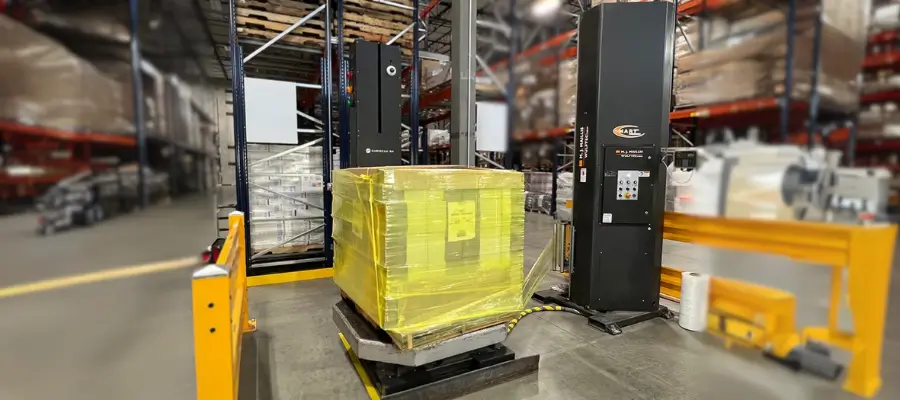
Measuring a fully built, stretch-wrapped pallet at the outbound dock is harder than it sounds. Pallet contents extend past the deck in irregular ways. Wrapping changes the outer profile. Dock associates measuring with a tape measure under throughput pressure produce results that vary by person and by shift. That variability is the source of most pallet dimension discrepancies.
Automated pallet dimensioners placed at outbound dock lanes solve this at the measurement point. The system captures the full pallet profile after wrapping, without the operator variability that manual measurement introduces. Cubiscan’s pallet dimensioning line, including the Cubiscan S9 and Cubiscan 1200, is designed for dock-speed capture tied to shipment records and documentation.
For LTL carriers: reducing revenue leakage
LTL carriers that deploy automated dimensioning at freight terminals capture the actual pallet dimensions at the point of receipt rather than relying on shipper-declared data. When the carrier’s measurement is the billing record rather than the shipper’s, class corrections happen at origin rather than post-delivery. That reduces disputed invoices, reduces the administrative cost of back-billing, and improves revenue accuracy on density-sensitive freight.
NTEP-certified measurement systems provide an additional layer of credibility when a shipper disputes a class correction. The carrier’s measured data is backed by a certified instrument rather than a manual tape read.
For LTL shippers: reducing post-shipment corrections
Shippers that measure outbound pallets before declaring dimensions have documentation to compare against carrier remeasurement. When a carrier sends a class correction, the shipper with its own measurement record can evaluate whether the correction is justified or worth disputing. Without that record, the shipper has nothing to compare against and typically absorbs the correction.
Cubiscan cubing software stores dimensional records with timestamps and shipment identifiers, making them searchable when a billing dispute needs documentation.
FAK agreements and knowing your freight profile
Freight All Kinds agreements set one rate for all freight classes. Whether that rate works in the shipper’s favor depends on the actual density distribution of their outbound freight. Without dimensional data, a shipper negotiating a FAK agreement is working from estimates. With outbound pallet measurement records across 12 months of shipments, the shipper can model the actual density distribution and evaluate whether the carrier’s proposed FAK rate is favorable.
Start with the right measurement infrastructure
To explore automated pallet dimensioning for outbound dock workflows, start with the dimensioning system overview. For questions about specific system configurations and how they connect to TMS and carrier billing platforms, contact Cubiscan.
Frequently asked questions
| How do pallet dimensions affect LTL freight class? LTL freight class is determined in part by density, which is calculated from weight divided by cubic volume. Pallet dimensions are the input to that calculation. When dimensions are inaccurate, the density calculation is wrong, which produces an incorrect class and a rate that may not hold when the carrier remeasures. |
| What causes discrepancies between shipper-declared pallet dimensions and carrier remeasurements? Manual measurement at the dock varies by operator and condition. Pallets measured with tape measures under throughput pressure produce different results across shifts. Automated pallet dimensioners eliminate that variability by capturing consistent measurements regardless of who is operating the system or when the measurement happens. |
| Can automated pallet dimensioning help with FAK negotiation? Yes. FAK rates are most favorable when the shipper knows the actual density distribution of their outbound freight and can evaluate whether the carrier’s proposed rate reflects a cross-subsidy that benefits or hurts their specific freight profile. Historical dimensional data from an automated system provides the inputs for that analysis. |
| What is NTEP certification and why does it matter for LTL billing? NTEP certification means a measurement device has been tested and verified by a third party to meet defined accuracy standards for commercial use. For LTL billing disputes, a certified measurement record carries more credibility than a manual tape read when the accuracy of the declared dimensions is questioned. |


