


Measuring freight used to mean a tape measure and a notepad. The associate measured the box, wrote down three numbers, and moved on. It worked because carriers were not verifying declared data with the same precision they use today. The economics of shipping have changed that. Dimensional weight pricing, density-based freight classification, and automated carrier verification have raised the cost of inaccuracy, and the technology for capturing accurate dimensions has responded at each step.
Stage 1: Manual measurement
The tape measure era is not as far behind as the technology conversation suggests. Many warehouses still use manual measurement for some dimensional capture. Manual measurement works at low volume, low frequency, and low stakes. The problems begin when any of those conditions change. At scale, manual measurement introduces variance from inconsistent technique, inconsistent rounding, and the normal performance degradation that comes with repetitive tasks under time pressure. A shift that starts measuring carefully at 7 AM may be measuring much less carefully at 4 PM when the dock is full and trailers are waiting.
Stage 2: Early static dimensioning systems
The first generation of automated dimensioning replaced manual measurement with sensor-based capture. Static systems used laser arrays or mechanical guides to capture the dimensions of items placed in a defined measurement zone. These systems eliminated the human variability in the measurement itself. An associate presented the item, the system captured the dimensions, and the record was saved. Accuracy was consistent across shifts and operators because the measurement was a system output.
The limitation was range. First-generation systems had defined measurement envelopes that worked well for standard rectangular cartons but struggled with irregular shapes, polybags, and soft-sided packages. If it did not fit the measurement zone or did not hold a consistent shape, the system produced unreliable results.
Stage 3: Laser measurement and in-motion systems
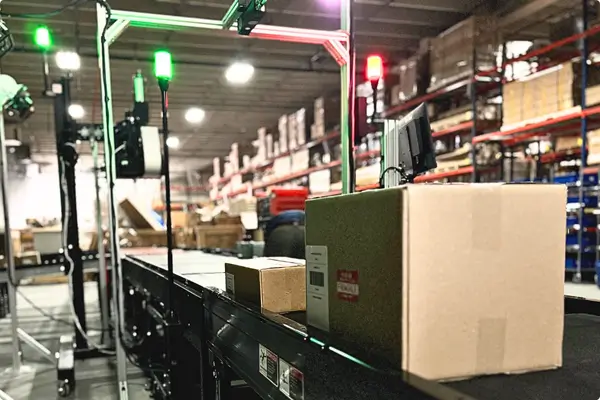
The next evolution expanded both accuracy and throughput. Laser-based measurement improved precision, and in-motion systems extended the workflow from static stations to conveyorized lines where packages are measured at production speed. In-motion dimensioning changed the economics of measurement: instead of one associate spending time per package at a workstation, the system captures dimensions continuously as packages move on the conveyor. This generation also improved integration. In-motion systems were designed to connect with WMS, TMS, and carrier platforms, sending measurement data downstream automatically.
Systems like the Cubiscan 200-SQ and Cubiscan 210-L represent this generation of in-motion technology, designed for SLAM line environments where dimensioning, labeling, and sortation are integrated into one end-of-line workflow.
Stage 4: Machine learning for irregular and non-rigid items
The capability gap that earlier generations could not close was irregular freight. A standard carton dimensioned well. A polybag, a mailer, a bulging box, a soft-sided case: these items defeated systems that relied on detecting the edges and corners of rigid shapes. Machine learning changed that. Instead of looking for geometric features that may or may not be present, ML-based dimensioning systems learn what a measurement should look like for a given item type and apply that understanding even when the item does not cooperate.
The Cubiscan 75 Pro is Cubiscan’s application of this approach. It uses machine learning to capture dimensions for parcels, flats, polybags, and mailers. For e-commerce and apparel fulfillment operations where polybags are a significant share of outbound volume, this capability change makes automated dimensioning viable for item types that previously required manual measurement.
What drove each evolution
Each stage of dimensioning evolution was driven by a real business pressure. From manual to static: carrier dimensional weight pricing created a financial incentive to measure accurately. From static to in-motion: high-throughput operations could not afford to stop the line for measurement. From standard to ML-based: e-commerce growth created outbound flows dominated by polybags and irregular items. According to FreightWaves, carrier surcharges and dimensional billing rules continue to expand, creating ongoing pressure to improve measurement accuracy.
The next generation starts with accurate measurement
Whatever the next phase of warehouse automation brings, it will depend on the same foundation every previous phase has needed: accurate, consistent dimensional data. The technology for capturing that data has never been better. To explore where current dimensioning technology fits in your operation, start with the dimensioning system overview. For discussions about how the technology fits your specific workflow, contact Cubiscan.
Frequently asked questions
| When did dimensional weight pricing start affecting warehouses? Major parcel carriers introduced dimensional weight pricing for ground shipments around 2015, which significantly increased the financial impact of inaccurate dimensions. LTL density-based classification has been expanding more recently, particularly with the 2025 NMFC overhaul. |
| What is the main limitation of traditional static laser dimensioning systems? Traditional static systems perform well on rigid rectangular cartons but struggle with irregular shapes, polybags, and soft-sided packages that do not present consistent geometric edges. Machine learning-based systems address this by learning measurement patterns rather than detecting geometry. |
| What does machine learning add to dimensioning accuracy? Machine learning allows dimensioning systems to handle items that do not conform to standard geometric shapes. Instead of relying on edge detection, ML systems learn from large numbers of measurement examples and produce accurate results for non-rigid items like polybags and mailers. |
References
• FreightWaves. Proliferation of Parcel Delivery Surcharges Drives Up Shipping Rates. https://www.freightwaves.com/news/proliferation-of-parcel-delivery-surcharges-drives-up-shipping-rates


