


Dimensional data has an obvious use in shipping: it feeds carrier declarations, drives billing accuracy, and creates a record for dispute resolution. But accurate weight and measurement data does something else too. It catches problems that would otherwise reach the carrier.
A package that is heavier than expected may have the wrong item inside. A parcel that measures outside its expected range may be packed incorrectly. A carton that is lighter than the shipment record says may be missing something. None of those problems show up on a label check. They show up when weight and dimensions are compared against expected values.
How weight and dimension verification works as a quality check
In an ideal workflow, each SKU has reliable expected weight and dimension data in the WMS or item master. When that data is current and accurate, the system can compare the measured package against expected values and flag anything that falls outside the acceptable range.
When an outbound package is measured and weighed, the system can compare actual values against expected values or approved tolerance ranges. If the measurement falls within the acceptable range, the package can continue through the workflow. If it falls outside that range, the package can be flagged for review.
This quality gate happens as part of the measurement workflow already needed for carrier billing. The additional logic is in the comparison, not the measurement itself.
What dimensional quality checks catch
Wrong items in the box can be flagged when a package is heavier or lighter than expected. The dimensional or weight variance does not diagnose the issue by itself, but it gives the team a clear reason to review the shipment before it reaches the carrier. This is especially useful in high-SKU environments where visual checks are impractical at outbound volume. Missing components appear when a package is lighter than its expected weight. That catch at outbound is cheaper than a customer service call, a reship, and a return. Overstuffed cartons are flagged when a package measures larger than its declared or expected dimensions, which creates both a dimensional billing problem and a potential damage-in-transit issue. Damaged packaging can also be flagged: a carton deformed enough to fall outside expected dimensions will trigger a review even if the label looks clean.
Building the measurement foundation for quality verification
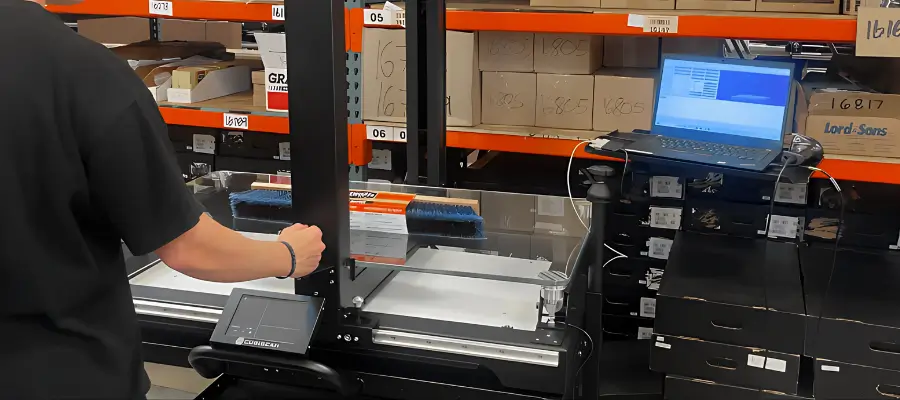
Quality checking at shipping requires reliable expected values and accurate measurement at the point of capture. Reliable expected values come from accurate item master data. When item dimensions and weights in the WMS reflect actual physical measurements, the comparison is meaningful. For building and maintaining accurate item master data, the Cubiscan 25 item master data solution and the Cubiscan 325 are commonly used at receiving and measurement stations.
Accurate outbound measurement comes from a consistent capture process. Static stations work for operations where packages stop at a workstation. In-motion systems capture measurements at conveyor speed. The dimensioning system overview covers the full range of options for outbound measurement.
Where quality checks fit in the outbound workflow
When the workflow allows, the strongest placement for dimensional quality checks is after packing and before final label application or carrier processing. At that point, the package reflects its final state, and the team still has time to correct issues before the shipment is fully committed to the carrier workflow.
At that point, the package reflects its final state, there is still time to resolve problems before a label creates a carrier record, and exceptions can be routed to a rework lane without holding up the main line. When the quality check happens after label application, correcting a problem requires reprinting the label and potentially reprocessing the shipment.
For operations with in-motion lines, exception divert keeps the main flow moving while quality issues are resolved offline. The automated warehouse shipping solution describes how exception handling fits into an integrated end-of-line workflow.
The connection to carrier accuracy
A package flagged for wrong weight before carrier pickup is a package that does not create a billing correction. A carton caught with dimensional irregularities before loading is a package that does not generate a damage claim. FreightWaves has reported that carriers are expanding surcharges and tightening dimensional billing logic. Operations that catch measurement anomalies before carrier pickup are in a better position to control those costs.
Make measurement do double duty
A package flagged for a weight or dimensional issue before carrier pickup is a package the team can correct before it becomes a billing problem. A carton caught with dimensional irregularities before loading can be reviewed before it creates avoidable rework, adjustment risk, or potential damage concerns. Catching these anomalies earlier gives operations more control before the shipment enters the carrier network.
To explore how dimensional data can support quality verification in your operation, start with the dimensioning system overview. For item master data quality as a foundation, see the Cubiscan 25 item master data solution. To discuss your specific workflow, contact Cubiscan.
Frequently asked questions
| Can a dimensioning system check whether the right item was shipped? \It can flag packages whose weight or dimensions fall outside the expected range for the assigned SKU. That flag prompts a manual check, which can catch wrong items, missing components, or packing errors before the package is labeled and loaded. |
| What is the best placement for a dimensional quality check in outbound? After packing and before label application is the most effective point. Problems can be resolved without reprinting labels or reprocessing the shipment in the carrier system. |
| How does item master data quality affect outbound quality checks? Quality checks compare measured values against expected values. If the expected values are wrong because item master data was never updated after a packaging change, the check produces false positives that erode confidence. Clean item master data is the prerequisite for effective quality verification. |
References
• FreightWaves. Proliferation of Parcel Delivery Surcharges Drives Up Shipping Rates. https://www.freightwaves.com/news/proliferation-of-parcel-delivery-surcharges-drives-up-shipping-rates


