


Third-party logistics providers face billing pressure from both directions. On one side, carriers are adjusting invoices based on their own dimensional measurements, often weeks after the shipment left the building. On the other, clients are disputing storage and shipping charges without documentation to reference. Dimensioning systems address both problems by creating a verified record at the time of measurement, one that belongs to the 3PL and can be produced in any billing conversation.
The two billing problems 3PLs face
Carrier adjustments arrive when the carrier’s measurement of a package differs from the declared dimensions on the label. For a 3PL processing hundreds of client shipments per day, those adjustments accumulate into a real cost. Some 3PLs absorb them. Others pass them to clients, which creates a different problem: the client disputes the charge because the adjustment came from the carrier’s measurement, not a document the 3PL can show.
Client billing disputes often center on storage and outbound charges that weren’t documented at the point of transaction. A client questions a storage cube charge or a dimensional weight billing line and the 3PL has to respond with something more than an assertion. If the measurement happened at a manual station with no permanent record, the response is weak.
Dimensioning as the source of truth
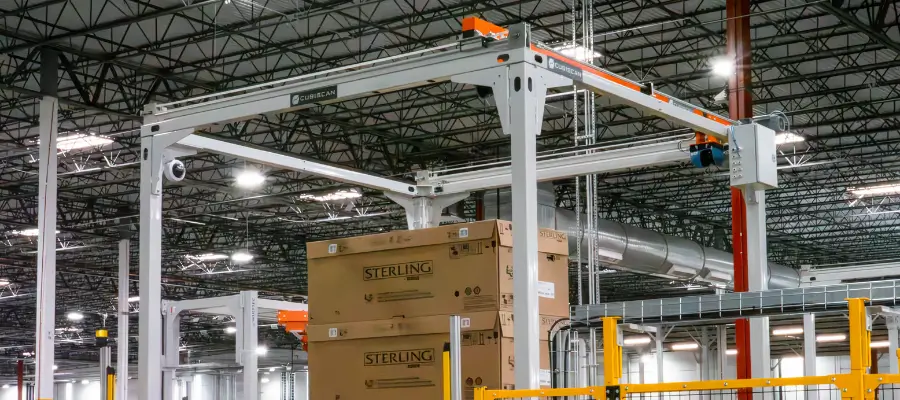
When outbound packages are dimensioned and weighed at ship time, the record created at that moment is the 3PL’s documentation. It has a timestamp, a station identifier, a package or order ID, and the actual dimensions captured by the system. That’s the record the 3PL produces when a carrier adjusts an invoice. That’s the record the 3PL produces when a client questions a billing line.
The dimensioning system overview covers the measurement options available for different outbound volumes and workflow configurations. For 3PLs with high outbound volume, in-motion systems like the Cubiscan 200-SQ capture dimensional records at conveyor speed without disrupting the outbound flow.
Storage billing and item master accuracy
Outbound billing is only part of the picture for 3PLs that charge for storage by cube. Accurate storage billing requires accurate item dimensions in the WMS. If the WMS is working from supplier-provided dimensions or estimated data, the storage billing calculation is only as accurate as those inputs.
Dimensioning at receiving solves this at the source. When items are measured when they arrive rather than when they ship, the WMS item master reflects the actual physical product from the start. Storage cube calculations run on real dimensions, and the documentation for each item’s footprint exists from day one of inventory.
Multi-client environments and client-specific records
3PLs managing multiple clients on shared infrastructure need records that are attributable at the client level. Cubiscan cubing software manages dimensional data across facilities and clients, keeping records accessible and searchable by shipment, order, or client account. When a billing question comes in from a specific client, the supporting documentation is retrievable without a manual investigation.
Carrier invoice reconciliation
Some 3PLs use dimensioning records to run their own carrier invoice audits. When the 3PL’s measured dimensions are on record for every outbound package, comparing that data against carrier invoices is a systematic process rather than a reactive one. Adjustments that don’t match the 3PL’s measurement record can be challenged with documentation, rather than accepted because there’s nothing to dispute them with.
For 3PLs building toward a complete automated outbound workflow, the automated warehouse shipping solution page describes how dimensioning, labeling, and sortation connect into an end-of-line system that produces verified records at every step.
Build a billing operation that can defend itself
To explore how dimensioning fits your 3PL’s outbound and storage billing workflows, start with the dimensioning system overview. For questions about multi-client configurations and data management, contact Cubiscan directly.
Frequently asked questions
| How does a dimensioning system help a 3PL respond to carrier billing adjustments? When outbound packages are dimensioned at ship time, the 3PL has a measurement record tied to each shipment with a timestamp and station identifier. When a carrier adjusts an invoice based on their own remeasurement, the 3PL can compare the carrier’s measurement against its own record and dispute adjustments that don’t align. |
| Can dimensioning systems support storage billing accuracy, not just outbound? Yes. Dimensioning at receiving captures item dimensions when inventory arrives and feeds the WMS item master. That data supports storage cube calculations from the start of the inventory lifecycle, reducing the risk of billing disputes over storage charges that clients question because the underlying measurement isn’t documented. |
| How do 3PLs keep client billing records separate when processing multiple clients on the same line? Dimensioning systems integrated with cubing software can attribute measurement records to the correct client account at the time of capture. That traceability makes client-specific billing reports and dispute documentation faster to produce without requiring manual reconciliation after the fact. |
| What is the difference between a 3PL absorbing carrier adjustments and passing them to clients? When a 3PL absorbs adjustments, the cost hits the 3PL’s margin directly. When adjustments are passed to clients, the 3PL needs documentation to justify the charge. Without a measurement record from the 3PL’s own system, that justification is weak. Dimensioning creates the record that makes the charge defensible. |


