


Let’s start with a number that should make every carrier wince a little: 58% of truckloads moved partially empty in 2024, according to a Flock Freight study. FreightWaves also highlighted similar underutilization findings for 2023.
That “empty space” is not free. It’s paid for in equipment, labor, and fuel. And it shows up in emissions too: freight transportation contributes about 8% of global greenhouse gas emissions, and can be as high as 11% when warehouses and ports are included.
So yes, maximizing truck space is an efficiency play. It’s also a sustainability play. Also, it’s a sanity play for anyone who has ever watched a half-full trailer roll out and thought, “Cool, cool, love that for us.”
This is where dimensioning systems come in.
What “Maximizing Truck Space” Really Means For LTL Carriers
Maximizing space is not about cramming freight like a carry-on bag. It’s about better decisions earlier:
- Better cube planning for outbound trailers
- Fewer surprises at the dock
- Fewer rehandles because something “didn’t fit like it should”
- More consistent rating, billing, and documentation when freight changes hands
All of that starts with one thing carriers can control: accurate dimensional data.
Why Dimensioning Systems Matter in Carrier Terminals
When dimensions are estimated, the network plans off guesses. Guessing leads to:
- Conservative load plans (which usually means more trailers)
- Last-minute reshuffles (which usually means more touches)
- Disputes and rework (which always means more time)
A dimensioning system turns freight into data you can build a plan around, consistently, across terminals, shifts, and operators.
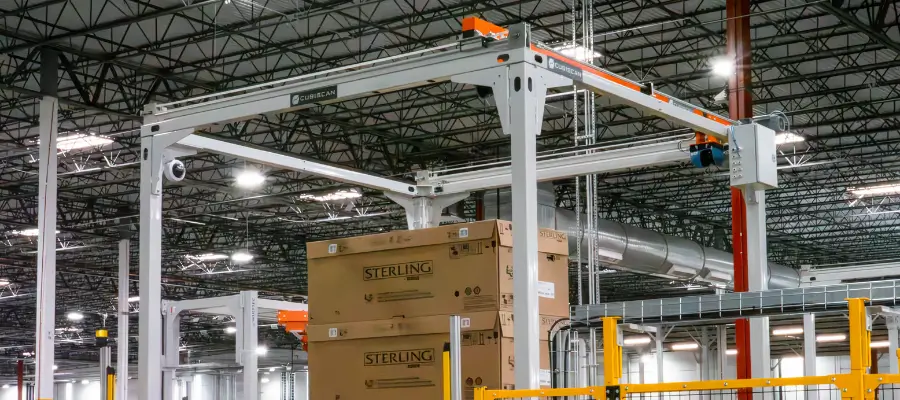
For LTL and palletized freight, Cubiscan’s carrier solutions are built around capturing dimensional data at the terminal. Start here: LTL carrier dimensioning systems.
How Carriers Use Dimensional Data to Load Smarter
1) Trailer build based on cube, not optimism
Accurate length, width, and height let load planners build trailers that are fuller without becoming unsafe or chaotic. You can spot when a lane is routinely leaving cube on the table and take action, instead of blaming it on “how freight showed up today.”
2) Fewer “surprise pallets” that blow up the plan
The freight that hurts utilization is usually the freight no one measured properly. Oversized, irregular, or “ugly pallets” have a way of showing up right after you thought the load was set. Cubiscan calls out measuring both uniform and ugly pallets for carriers, because that’s real life on a dock.
3) Fewer touches and exceptions
Every rehandle is a small tax. Multiply it across a network, and it’s not small anymore. When freight is dimensioned up front, teams spend less time reworking builds and more time moving freight.
Where to dimension for the biggest impact
You don’t need to scan everything everywhere. You need to scan where it changes outcomes.
Inbound check-in or receiving lanes
Capture dimensions when freight enters the terminal, especially for high-variance customers and irregular freight. This is where you prevent bad data from spreading.
Rework areas and consolidation points
If freight is rewrapped, restacked, or consolidated, dimension again. That creates a clean record of what actually shipped, not what was originally tendered.
Outbound build verification
Dimensioning at outbound helps confirm what is leaving matches the plan. It’s also useful for documentation when freight gets questioned later.
What to look for in a carrier-ready dimensioning system
Dimensioning systems succeed or fail based on dock reality. Here’s what carriers should prioritize.
Freight flexibility
Uniform pallets are the easy mode. Systems also need to handle oversized items, irregular shapes, and freight that arrives looking like it lost a fight with shrink wrap.
Throughput and footprint
A dimensioning lane that becomes a bottleneck is not a win. The right setup fits the flow of your operation, not the other way around.
Uptime and serviceability
If a system is down, teams go back to estimates. Cubiscan emphasizes total cost of ownership and long lifespan for the Cubiscan 1200.
Data integration and reporting
Dimensioning is only valuable if the data gets used. You want dimensional records that can flow into rating, billing, claims, and analytics.
Cubiscan’s Qbit software suite is designed to collect, store, export, and integrate dimensional data, which is what turns scan events into something your whole network can act on.

The fast “carrier playbook” to improve trailer utilization
Here’s what we recommend when carriers want quick progress without a massive overhaul.
- Start with one lane, one terminal, one measurable goal.
Pick a target: improve average cube utilization, reduce rehandles, reduce short-notice extra trailers. - Focus on the freight that drives the most chaos.
That’s often oversized, irregular, and frequently reworked freight. It’s also often the freight with the worst dimensional data. - Standardize the scan record.
Dimensions, timestamp, terminal ID, shipment identifier. If you’re supporting disputes, add photos where possible. - Make the data visible.
If supervisors can’t see cube trends and exception rates, improvements will stall. Put reporting in front of the people who run the dock. - Scale once the process is boring.
“Boring” is good. It means the workflow is consistent, training is simple, and the data is reliable.
To explore options, start with Shop Dimensioning Systems, then dig into carrier applications on LTL carrier dimensioning systems and the Cubiscan 1200 for carriers.
Next step: Stop paying for air
Trailer space is one of the few cost lines that shows up everywhere: network performance, labor, equipment, and sustainability reporting. Better dimensional data is how carriers turn space into something measurable and manageable.
If you want to map dimension capture points to your terminal flow and freight mix, Request a Quote or reach out through Contact Cubiscan.


