


Systems integrators are responsible for more than selecting equipment. They are trusted to design connected workflows that perform reliably, reduce operational risk, and create measurable ROI for the client. Dimensioning technology can play an important role in that larger automation strategy because it gives connected systems the accurate physical data they need to make better decisions. When dimensioning is brought into the project early, it helps improve WMS accuracy, reduce carrier billing adjustments, lower exception rates, and provide a data foundation that strengthens the performance of every system around it.
Why dimensioning belongs in automation conversations early
Most automation projects begin with conveyors, WMS implementation, sortation, or labor-saving equipment. Dimensioning is often added later as a point solution, usually after a client has already experienced billing adjustments, bad master data, or outbound exceptions. Bringing dimensioning into the conversation earlier allows the integrator to design measurement into the workflow from the start, improving the quality of the data that feeds the WMS, TMS, cartonization logic, sortation rules, and carrier-facing records.
That difference has real consequences for the client. A WMS configured around accurate item dimensions performs better from day one. Sortation rules built on verified package sizes divert fewer exceptions. Carrier billing declarations supported by measured data can help reduce post-shipment corrections. FreightWaves has documented the ongoing expansion of carrier surcharges and dimensional billing requirements. For clients with high outbound volume, that environment makes the case for dimensioning investment straightforward.
Where dimensioning creates opportunity for integrators
For systems integrators, dimensioning is not just a component that benefits the client. It is also an opportunity to expand project scope, improve the overall solution quality, and build a stronger business case for the automation investment.
Dimensioning gives integrators a way to solve data problems before they become system problems. When item master data is inaccurate, it affects WMS slotting, cartonization, outbound declarations, and billing. When outbound packages are not measured, the carrier’s measurement becomes the billing record. Bringing dimensioning into the design phase means those gaps are addressed in the architecture rather than worked around after implementation.
Accurate dimensional data also strengthens the ROI justification for the broader project. Reduced billing adjustments, lower exception rates, and improved storage utilization can be measurable outcomes that clients track. These give integrators a stronger business case during project planning and help justify dimensioning as part of the larger automation investment.
How dimensioning fits across project phases
Integrators think in phases. Dimensioning fits into each one differently.
Discovery
Identify data gaps early. Are item master dimensions accurate and complete? What does the current outbound billing error rate look like? Where do exceptions originate in the current workflow? The answers shape where measurement needs to happen and what systems it needs to feed.
Design
Map measurement points deliberately. Does dimensioning need to happen at receiving to feed the WMS item master? At pack-out for order verification? At the outbound line for carrier billing? Not every workflow needs every measurement point, but those decisions should be made as part of the system design rather than left to default.
Implementation
Confirm data flow before go-live. What identifier ties the measurement record to the order or shipment? How does the record reach the WMS, TMS, or carrier platform? What happens when a package fails a verification step? Answering these questions during integration testing prevents data gaps from surfacing in production.
Handoff and support
Document calibration and exception workflows clearly. Dimensioners require periodic calibration to maintain accuracy. The handoff documentation should include how calibration is performed, at what interval, and what the exception handling process looks like when a package fails a measurement step. This is part of the long-term operational success of the system.
The integration points that matter most
Dimensioning connects to the automation stack at several points. For each, there are practical questions integrators should be working through during the design phase.
WMS integration
Dimension records captured at receiving, onboarding, or workstation measurement points can feed the WMS item master, helping teams maintain accurate SKU, case, and package data without relying on manual entry. Key questions: What system owns the master item record? How are updates to existing SKU dimensions handled? What is the tolerance for data refresh cycles?
TMS and carrier platform integration
Outbound dimensioning feeds declared weights and dimensions into the TMS or carrier platform for billing and compliance. Key questions: Where in the outbound flow does the declaration need to be finalized? What identifier ties the dimensional record to the shipment or carrier label? How are adjustments and disputes documented when a carrier measures differently?
Conveyor and sortation integration
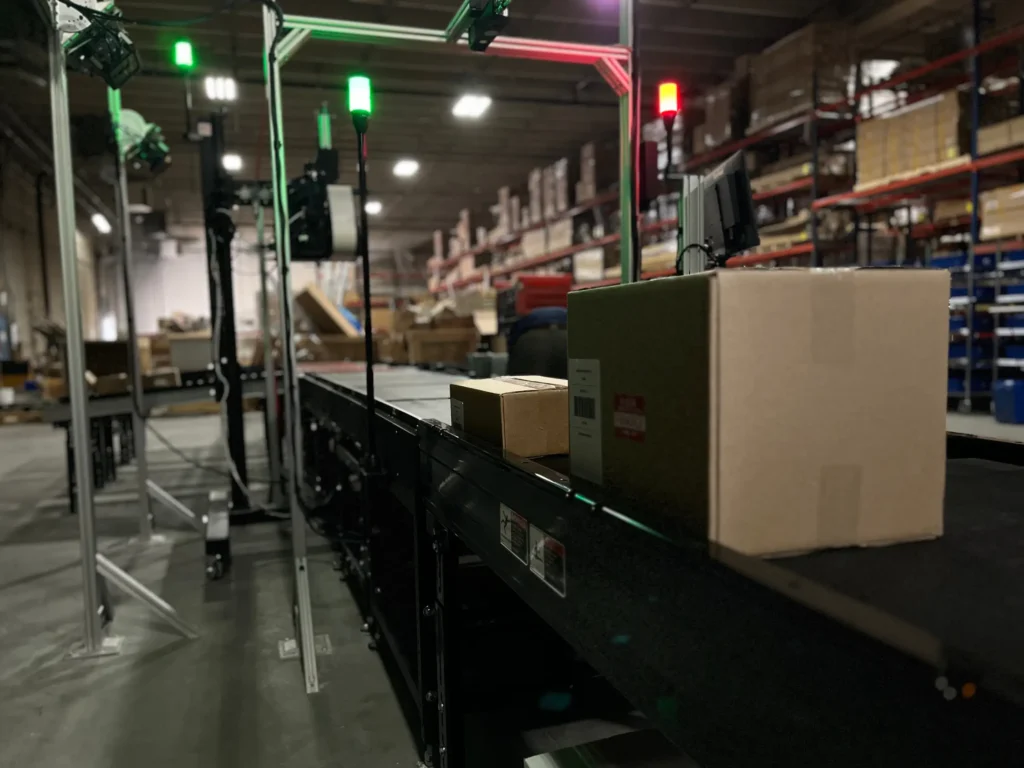
In-motion systems measure packages at line speed and pass dimensional data to downstream sortation, enabling size-based divert logic. Key questions: What triggers a divert (dimensional thresholds, barcode failures, or both)? Where does the exception lane feed, and what is the rework process? What data needs to pass back to the WMS or TMS when a package diverts?
Print and apply integration
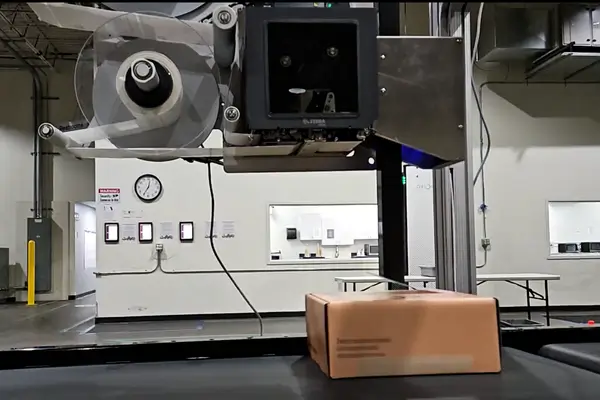
Dimension capture tied to a print and apply system creates a workflow where the label is generated from the verified measurement record. Key questions: What system owns the shipment ID? Where does the dimensional record need to be stored? What happens when a package fails measurement before a label is generated?
The automated warehouse shipping solution page describes how dimensioning, labeling, and sortation connect as an integrated end-of-line system. Cubiscan cubing software supports the data management layer that connects measurement records to downstream systems.
Matching dimensioning systems to client workflows
For integrators, hardware selection is a workflow matching exercise, not a product catalog decision. The right system depends on what the client is measuring, where in the facility it needs to happen, and what systems the data needs to feed.
Static workstation systems may be a fit for receiving, SKU onboarding, master data programs, and lower-volume shipping workflows. The Cubiscan 75 Pro handles mixed parcel packaging, including parcels, flats, polybags, mailers, and some irregular-shaped items. The Cubiscan 100 is designed for both shipping and receiving workflows. For high-precision master data programs, the Cubiscan 325 is commonly used for its measurement precision and repeatability over time.
Parcel-focused in-motion systems support conveyorized workflows where packages need to be measured without slowing the line. The Cubiscan 200-SQ is designed for automated outbound workflows at line speed.
For pallet and LTL measurement workflows, Cubiscan offers systems designed to support outbound dock lanes, freight classification, shipment documentation, and billing accuracy. Depending on the application, this may include solutions such as the Cubiscan S9, Cubiscan N9, or Cubiscan 1200. A Cubiscan specialist can help match the right pallet or LTL dimensioning system to the client’s dock layout, shipment profile, software environment, and measurement workflow.
How dimensioning improves the client ROI story
Clients evaluate automation projects on ROI. Dimensioning can contribute through several measurable channels: fewer carrier billing adjustments, because accurately dimensioned outbound packages can reduce post-shipment corrections; improved storage utilization, because accurate item master data helps the WMS assign locations correctly and improve cube utilization; labor efficiency, because automated dimensioning reduces manual measurement work at receiving, pack-out, and the dock; and fewer rework events, because exception handling can improve when dimensions and labels are verified together.
These outcomes give integrators a stronger business case during project planning and help justify dimensioning as part of the larger automation investment. They are also outcomes that can be estimated before the project begins and measured after implementation is complete.
Dimensioning as a technical partnership
Dimensioning technology is not just a standalone piece of equipment. When integrated well, it strengthens the accuracy and reliability of the systems around it: the WMS, TMS, sortation system, print and apply workflow, and carrier-facing records. For systems integrators, that means fewer data gaps, stronger ROI justification, and a more complete automation solution for the client.
Cubiscan can support integrator-led projects with hardware guidance, workflow planning, and technical coordination to help ensure the measurement layer fits the broader system design. To explore equipment designed for integrator-led projects, review the Cubiscan system integrator page or contact Cubiscan to discuss specific project requirements.
Frequently asked questions
| Why should systems integrators recommend dimensioning as part of automation projects? Dimensioning helps improve the accuracy of connected systems including WMS, TMS, and sortation. It can reduce carrier billing adjustments, improve storage utilization, and lower exception rates, all of which contribute to the client’s ROI and the integrator’s project success. Bringing dimensioning into the design phase, rather than adding it as a retrofit, allows the data flow to be planned from the start. |
| What are the most important questions integrators should ask when designing dimensioning into a project? Key questions include: What system owns the shipment ID? Where does the dimensional record need to be stored? What happens when a package fails measurement or barcode verification? What data needs to pass back to the WMS or TMS? Working through these in the design phase prevents integration gaps during implementation. |
| Does Cubiscan work directly with systems integrators? Yes. Cubiscan supports systems integrators with technical resources, project coordination, hardware guidance, workflow planning, and integration-focused support to help ensure the measurement layer fits the broader system design. |
| How does in-motion dimensioning connect to sortation systems? In-motion dimensioners pass dimensional data to sortation control logic, which can use package size as a routing criterion. Packages outside defined size thresholds can be diverted to exception or special handling lanes automatically, without stopping the mainline flow. |
References
• FreightWaves. Proliferation of Parcel Delivery Surcharges Drives Up Shipping Rates. https://www.freightwaves.com/news/proliferation-of-parcel-delivery-surcharges-drives-up-shipping-rates


