


Parcel dimensioning systems fall into two categories: static and in-motion. Both capture length, width, height, and weight. The difference is when and how they do it. Choosing the wrong type doesn’t mean the system fails. It means it either creates a throughput problem you didn’t need, or doesn’t keep pace when volume demands it.
What a static dimensioner does
A static dimensioner measures a package while it’s at rest. The operator places the item at the measurement point, triggers the capture, and the system records the dimensions. It can be a countertop unit at a pack station, a receiving desk, or a dedicated measurement station.
Static systems are a strong fit for operations where throughput doesn’t require conveyor-speed capture: pack-out workflows, receiving stations, item master data collection, and new product onboarding. They also tend to handle irregular items and soft goods more consistently in a controlled environment. The Cubiscan 100 is designed for both shipping and receiving workflows. The Cubiscan 325 is commonly used in master data programs that require precision and repeatability over time.
What an in-motion dimensioner does
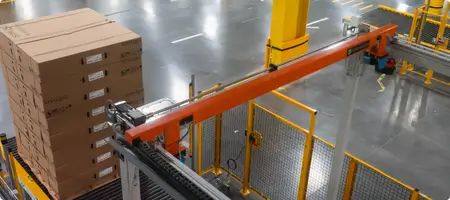
An in-motion dimensioner measures packages as they travel on a conveyor, without stopping the line. The system triggers on package presence, captures dimensions mid-travel, and passes the record to downstream systems in real time: TMS, WMS, print and apply, sortation.
In-motion systems are designed for high-volume outbound lines where any interruption in flow creates a bottleneck. SLAM lines, automated shipping lines, and parcel sortation environments are the most common deployments. The Cubiscan 200-SQ is built for automated outbound workflows at conveyor speed.
Throughput: the first decision point
Start with your outbound parcel volume per hour. Static measurement requires manual handling between each item. At 100 to 200 parcels per hour, that’s manageable. At 400 or 500 per hour, manual-trigger measurement becomes the constraint, not the carrier, not the sorter, the measurement station.
In-motion systems become the practical choice when throughput requirements exceed what stop-and-measure handling can sustain. If you’re running a high-volume outbound line and dimensioning isn’t on the conveyor, you’re either measuring before or after the bottleneck, or not measuring at all.
Packaging mix: the second decision point
Traditional in-motion systems perform best on rigid packages with consistent geometry and predictable conveyor orientation. Polybags, mailers, and soft-sided items create measurement variability because the package shape changes between measurements.
If your outbound includes a significant percentage of non-rigid items, a static workstation system or an ML-enabled system is typically more reliable. The Cubiscan 75 Pro uses machine learning to handle polybags, flats, and irregular items at workstation speed, without the geometry assumptions that trip up conventional systems.
Integration and infrastructure
In-motion systems require conveyor infrastructure: triggering mechanisms, encoder integration, and tight coordination with print and apply, sortation, and manifest platforms. Static systems typically connect to the WMS or manifest system through a simpler integration path.
That doesn’t make one more complex than the other in absolute terms. It means the project scoping is different. An in-motion installation involves more surrounding infrastructure and more integration touchpoints. If your facility doesn’t have an established outbound conveyor, that’s a factor in the total investment calculation.
Find the right fit for your operation
The dimensioning system overview covers Cubiscan’s full product range across both categories. For help matching a system to your outbound volume, packaging mix, and integration environment, contact Cubiscan.
Frequently asked questions
| What is the main difference between a static and in-motion dimensioner? Static dimensioners measure packages at rest, at a pack station or receiving dock. In-motion dimensioners measure packages on a moving conveyor without stopping the line. The right choice depends on throughput requirements, packaging mix, and workflow design. |
| Can an in-motion dimensioner handle polybags and irregular items? Most conventional in-motion systems perform best on rigid packages with consistent geometry. For soft goods, polybags, and irregular items, a static workstation system or a machine learning-enabled system such as the Cubiscan 75 Pro is typically more reliable. |
| At what volume should I consider moving from static to in-motion dimensioning? There is no single threshold, but operations processing 400 or more parcels per hour typically find that static measurement creates a throughput bottleneck. In-motion systems become the practical choice when volume exceeds what manual-trigger measurement can sustain at line speed. |
| Do I need a conveyor to use an in-motion dimensioner? Yes. In-motion systems require conveyor infrastructure, including triggering systems that detect package presence and initiate measurement. Integrating an in-motion dimensioner into a new or existing line is part of the scoping and installation process. |


